
Why do I wake up at night?
Some waking is normal: you may wake briefly between sleep cycles and usually don't remember it [1]. Waking that you notice, often, can come from alcohol in the evening [2], noise, needing to urinate, or breathing problems in sleep [3]. When it goes on for weeks and affects your days, it may be insomnia, which has an effective treatment.
Last reviewed 24 September 2026. General information from the Snorezy team, not medical advice.
Normal waking
Sleep runs in cycles of about 80 to 100 minutes, and brief awakenings between them are normal [1]. Most are over in seconds and forgotten.
Things that fragment sleep
- Alcohol. It can help you fall asleep, but it disrupts the second half of the night [2]. See alcohol and sleep.
- Noise. Traffic, a partner, a pet or a door. Sounds you don't remember can still wake you.
- Needing to urinate. Waking to urinate is also one of the signs of sleep apnea [3].
- Breathing problems. Choking, gasping or snorting awake can be a sign of sleep apnea [3]. See sleep apnea.
- Caffeine, even taken hours earlier [4].
When it's insomnia
If you regularly struggle to fall or stay asleep and it affects your days, talk to a doctor about insomnia. The treatment sleep medicine recommends most strongly is cognitive behavioural therapy for insomnia (CBT-I), not pills and not sleep hygiene tips on their own [5].
In Snorezy
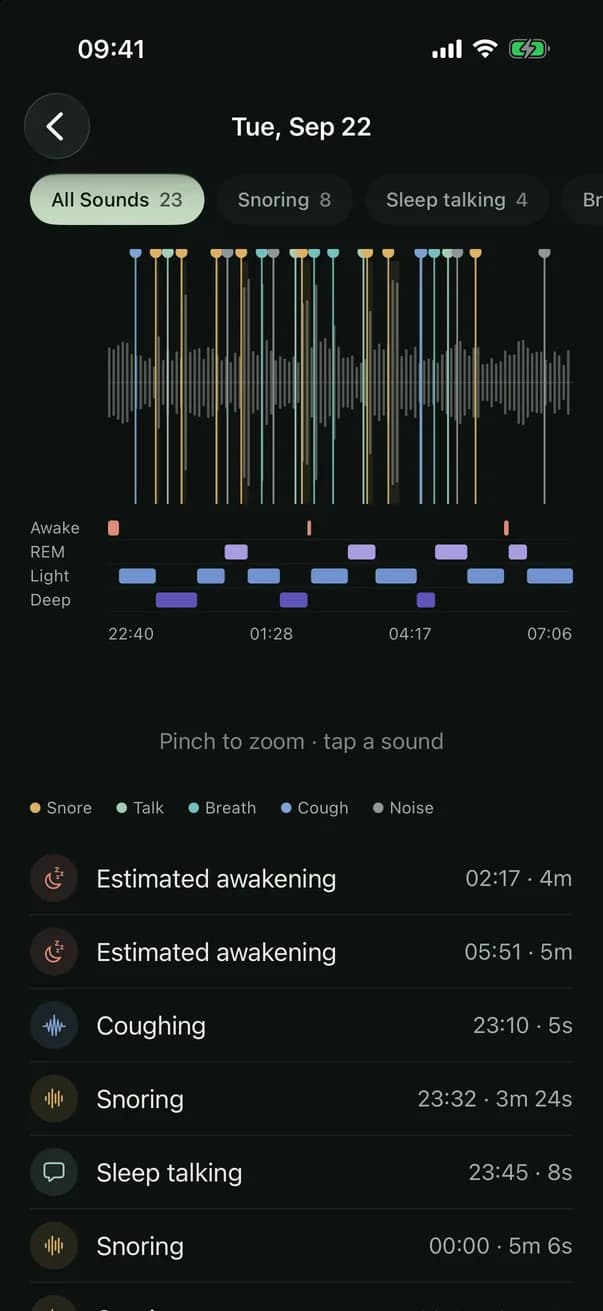
See what was happening when you woke
When Apple Health records an awakening, Snorezy looks at what the microphone heard in the minutes before it and puts the two side by side: a snore, a cough, a door. It says so carefully, because being close in time doesn't mean one caused the other.
Sources
- 1National Heart, Lung, and Blood Institute (NIH). How Sleep Works: Sleep Phases and Stages.
- 2Ebrahim IO et al. Alcohol and sleep I: effects on normal sleep. Alcohol Clin Exp Res. 2013;37(4):539-549.
- 3NHS inform. Obstructive sleep apnoea (OSA).
- 4Drake C et al. Caffeine effects on sleep taken 0, 3, or 6 hours before going to bed. J Clin Sleep Med. 2013;9(11):1195-1200.
- 5Edinger JD et al. Behavioral and psychological treatments for chronic insomnia disorder in adults: an American Academy of Sleep Medicine clinical practice guideline. J Clin Sleep Med. 2021;17(2):255-262.