

Sleep talking recorder for iPhone: find and replay nighttime speech
A sleep talking recorder helps you find possible speech, mumbles and laughter in overnight iPhone audio and replay clips rather than hunt through hours of recording. Labels are suggestions: a podcast, a partner or a quiet sound may be misclassified, and the app does not transcribe words. One silent night does not prove you never talk in your sleep.
General information, not medical advice.
On this page5 sections
Why a voice recorder struggles with sleep talking
Sleep talking is often intermittent: in a survey of 1,000 Norwegian adults, 66.8% reported having talked in their sleep at some point and 17.7% in the previous three months [1]. Those survey responses do not establish that any particular person's empty clip list means they never sleep talk.
A regular voice recorder can work if you are willing to listen through the recording. The advantage of an event-based recorder is a shortlist of possible speech clips, not certainty about which person spoke or whether the person was asleep.
What a sleep talking recorder should do
Four things matter more than anything else:
- Suggest talking separately from other noises, while still letting you check the recording because a partner or television can be mislabelled.
- Provide context before a suggested sound, when that audio was captured; a detector may still miss the beginning or an entire quiet utterance.
- Keep clips you can replay in order, with the time of each.
- Leave the words alone. What people say in their sleep is private, and much of it isn't words at all: in a sleep-lab study of 232 adults, most of them with sleep disorders, 59% of what they said was mumbles, shouts, whispers and laughs [2]. A recorder doesn't need to transcribe any of it to be useful.
This site is made by the app's developer; these are fair questions for any recorder, this one included.
How to review a suggested sleep-talking clip
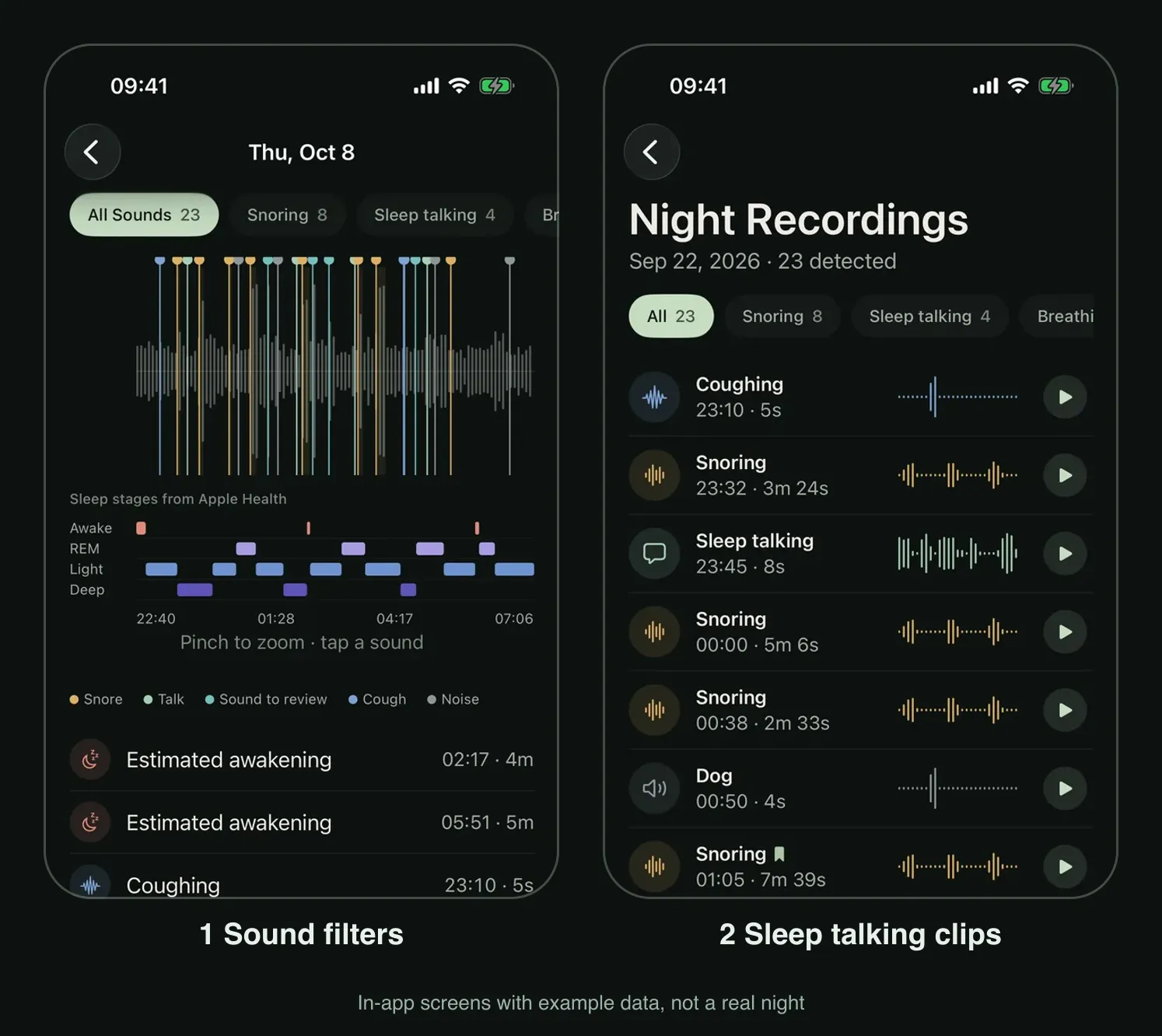
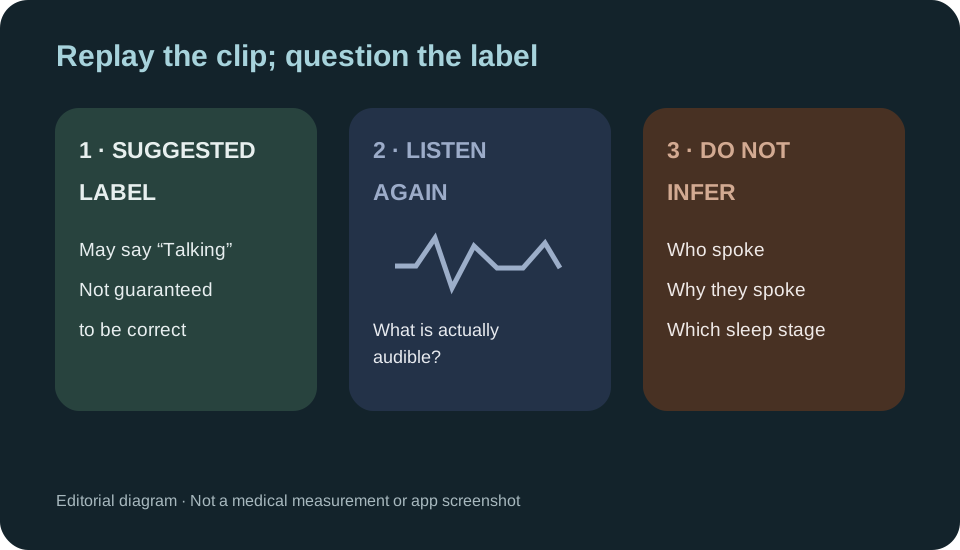
Open the suspected-talking filter, choose a timestamp and play the audio. The recording can establish that a sound was captured, but an automated category cannot prove who made it, what it meant or whether the person was asleep at that instant.
- First listen for a human voice versus a television, podcast, pet or another noise.
- If you hear a voice, do not assign it to yourself or a partner from the label alone; a shared microphone does not establish speaker identity.
- Keep the timestamp and replayable sound in context. If nothing is audible, treat the label as uncertain; a missing clip or period marked not recorded cannot prove that no one spoke.
Need a general sound timeline instead? Compare sleep recording apps or browse the recording guides.
Recording your sleep talking on an iPhone
Voices are usually quieter than snoring, so placement matters more:
- Put the iPhone close to your head, on the bedside table, with the microphone uncovered.
- Turn off a radio, podcast or television. A voice from a speaker can be mistaken for yours.
- Get agreement from everyone whose speech might be captured; one microphone cannot establish which sleeper spoke, and everyone should agree on playback or sharing.
- Before bedtime, replay a short waking test. In the morning, check the actual captured duration and any intervals marked not recorded; one quiet or interrupted night does not mean you never talk in your sleep.
For phone placement and permission checks, see how to record yourself sleeping.
What a recording can't tell you
A recording can establish that a speech-like sound was audible at a particular time, but it cannot by itself prove who spoke or whether that person was asleep. Nor does the microphone identify a sleep stage: people in sleep-lab observations spoke in both REM and non-REM sleep [2]. Audio fragments cannot establish dreams, motives or memories.
Whether your sleep talking is worth mentioning to a doctor depends on what comes with it, not on the recording. Sleep talking, explained covers when it is, and how common it is.
In the app
Sleep talking in the app
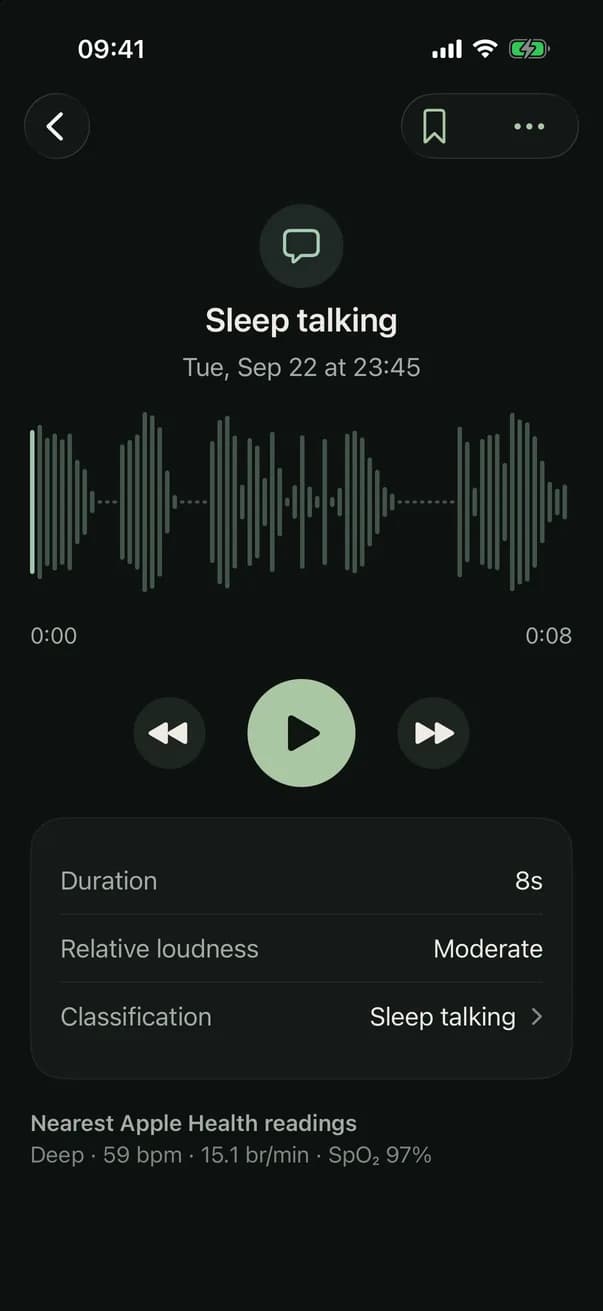
The app suggests speech-related moments in a Sounds list so you can filter and replay captured clips in timestamp order. Smart Recording retains suggested sound clips, while Full Recording keeps wider audio during recorded intervals; neither reconstructs an interruption. Its labels may miss quiet mumbling or mistake a different voice for yours. Optional Apple Health data is separate from microphone audio and cannot verify the speaker.
The app does not transcribe speech: you replay saved sound clips, but the sound-category labels and timestamps remain. The app stores recordings and reports locally, excluded from iCloud and device backups, with retention of 7, 30 or 90 days or until deleted. Exported copies can persist outside the app. Recording and reports need a subscription; plans and prices are shown in the app.

Questions
Can it record whole sentences?
A nearby iPhone may capture an intelligible sentence, but the audio cannot by itself confirm who spoke or whether they were asleep. Sleep-related sounds are often mumbled, whispered or not words at all [2].
Can I play a clip to the person who said it?
Ask permission before playing or sharing a clip containing someone else's speech. A category label cannot prove who spoke, and exported copies may remain with recipients even after you delete the original.
Will it pick up my partner talking too?
It can. The microphone hears anyone nearby and cannot reliably identify the speaker. Obtain agreement before recording, and follow applicable rules about capturing other people's voices.
Read in your language
This guide is translated into 28 other languages. The app interface may not offer every language shown here.
Sources
- 1Bjorvatn B, Grønli J, Pallesen S. Prevalence of different parasomnias in the general population. Sleep Med. 2010;11(10):1031-1034.
- 2Arnulf I, Uguccioni G, Gay F, et al. What Does the Sleeping Brain Say? Syntax and Semantics of Sleep Talking in Healthy Subjects and in Parasomnia Patients. Sleep. 2017;40(11):zsx159.A sleep-lab study in which most participants had a parasomnia, so it describes their sleep talking more than everyone's.