

Sleep apnea test: home tests, lab studies and AHI explained
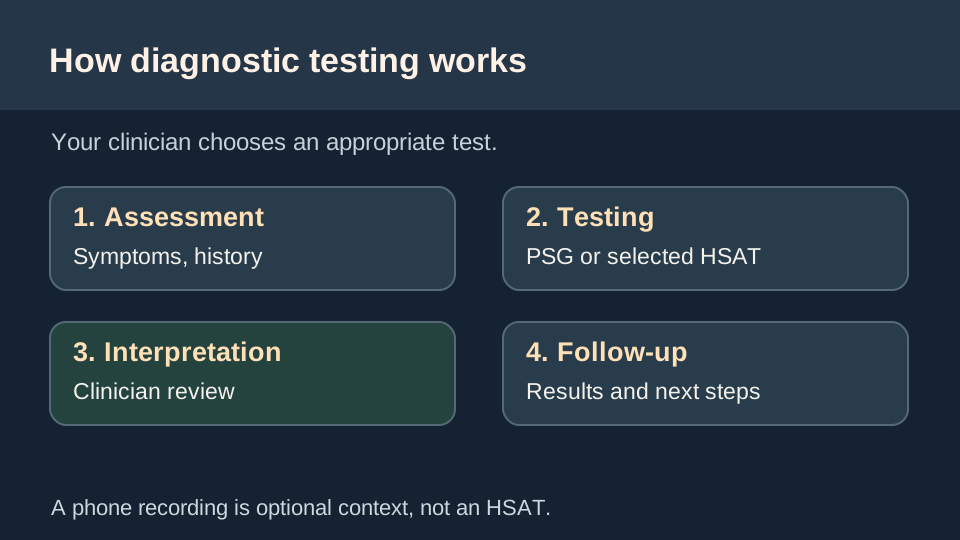
A clinician diagnoses obstructive sleep apnea using an appropriate sleep test, not by listening to a phone recording. In-lab polysomnography is the standard study. Some uncomplicated adults with symptoms suggesting moderate-to-severe OSA can instead have a clinician-ordered home sleep apnea test [1]. The right route depends on medical history, symptoms and the quality of the recorded signals.
Last reviewed 22 October 2026. General information, not medical advice.
On this page6 sections
How an in-lab sleep study works
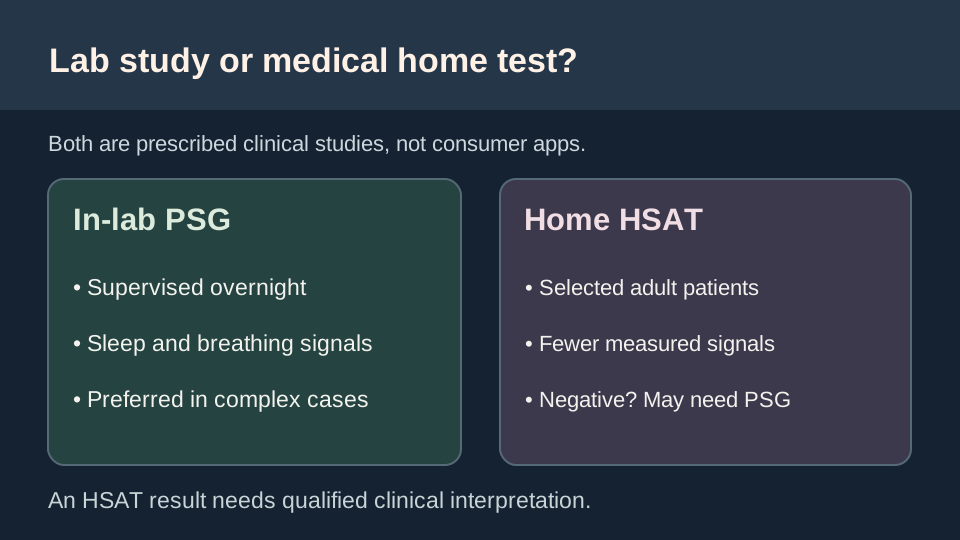
An overnight polysomnogram (PSG) is supervised in a sleep center. It commonly records brain activity, eye movement, muscle activity, breathing, respiratory effort, oxygen levels and heart rate. Those signals help a qualified professional identify events, sleep stages and the type of breathing problem [1][2].
A lab test may be preferable for people with significant heart or lung conditions, possible respiratory muscle weakness, suspected hypoventilation, chronic opioid use, past stroke or severe insomnia. The decision belongs to your healthcare team [1].
When a home sleep apnea test can be appropriate
A home sleep apnea test (HSAT) is a medical device kit, not a smartphone microphone app. It can monitor selected breathing-related signals while you sleep in your own bed. AASM guidelines recommend it for medically uncomplicated adults with signs and symptoms indicating increased risk of moderate-to-severe obstructive sleep apnea [1].
An HSAT is not suitable for everyone and is not a general screening tool for asymptomatic people. If one HSAT is negative, inconclusive or technically inadequate, the guideline recommends in-lab PSG when evaluating suspected OSA [1].
What AHI means and why it differs from an app count
The apnea-hypopnea index (AHI) counts qualifying breathing events per hour of measured sleep. In adults, clinical reports commonly use ranges of 5 to below 15 events per hour for mild, 15 to below 30 for moderate and 30 or more for severe obstructive sleep apnea, but diagnostic criteria and interpretation also depend on symptoms and the test type.
Many home devices cannot determine exact time asleep and instead report a respiratory event index (REI) using monitoring time. An REI and an AHI may differ. No sound-event count from the app should be converted into either number. Review the meaning of your result with the ordering clinician [1].
What to take to the appointment
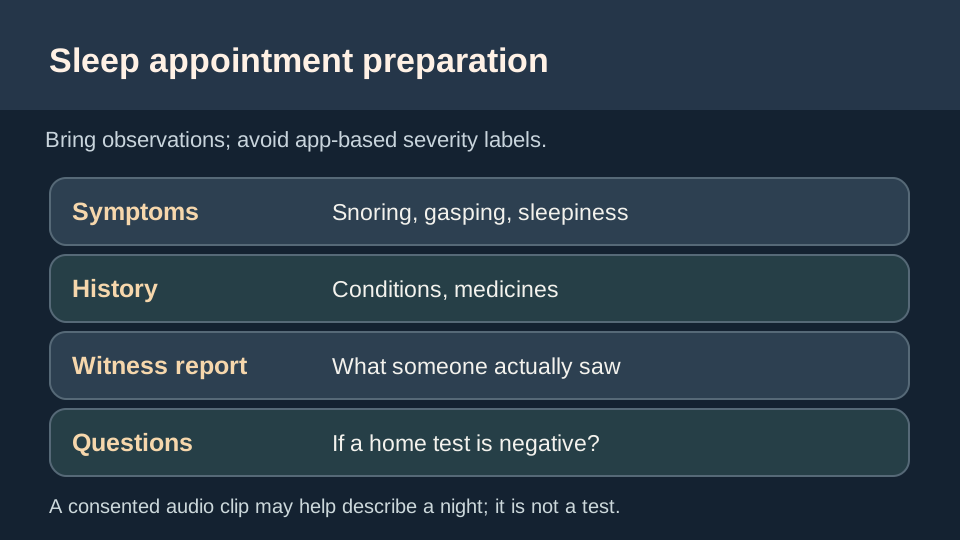
You do not need to arrive with a self-calculated apnea risk score. Useful background is what you or a partner observed, the time course of symptoms, your daytime sleepiness, relevant conditions and medicines, and any safety concerns [2].
- Note frequency of loud snoring, witnessed pauses or gasping, if known.
- Describe sleepiness, fatigue, morning headaches and concentration concerns.
- Bring a list of medicines and any relevant cardiac, respiratory or neurological conditions.
- If consent was obtained, bring a short representative audio clip as context only; do not describe a silent stretch as a stopped breath.
- Ask what happens if the first home test is unclear or negative despite continuing symptoms.
Before and after a prescribed home sleep apnea test
A clinician-ordered home sleep apnea test is not the same as a self-recorded night of iPhone audio. Your sleep clinic provides the device, sensor placement instructions and the steps for returning the equipment. Follow that clinic's instructions, including what to do if a sensor comes loose, rather than trying to use a general-purpose snoring app to fill a recording gap [1].
Ask how the clinic will check signal quality and how you will receive an interpreted result. The AASM guideline says a negative, inconclusive or technically inadequate single home test should be followed by in-lab polysomnography when evaluating suspected OSA. A phone recording cannot fix an inadequate medical test [1].
- Before the test: ask which sensors you will wear, what a normal setup looks like, and whom to contact if a sensor disconnects or the device fails.
- After the night: follow the clinic's return instructions and ask when a qualified clinician will review the actual physiologic signals.
- When reviewing the report: ask whether the figure is AHI or a home-test respiratory event index (REI), what recording time was used, and what uncertainty remains.
- If the result does not match ongoing symptoms: discuss whether an in-lab study is needed; do not use an app sound count as a second medical opinion.
The AASM adult diagnostic-testing guideline explains why technically adequate clinical testing, suitable patient selection and physician follow-up matter. For warning signs, revisit the sleep apnea overview.
After a test, what happens next?
The clinician interprets the physiological recording and talks through the type and severity of the condition, any uncertainty, and treatment options. If OSA is diagnosed, treatments may include positive airway pressure, dentist-fitted oral appliances or other individualized approaches [3][4]. Read sleep apnea treatment options.
If symptoms remain but an initial home study has not provided an answer, discuss further evaluation instead of concluding you are clear [1]. For the background, see what sleep apnea is and the limits of phone apnea apps.
In the app
Use a recording to describe symptoms, not replace a test
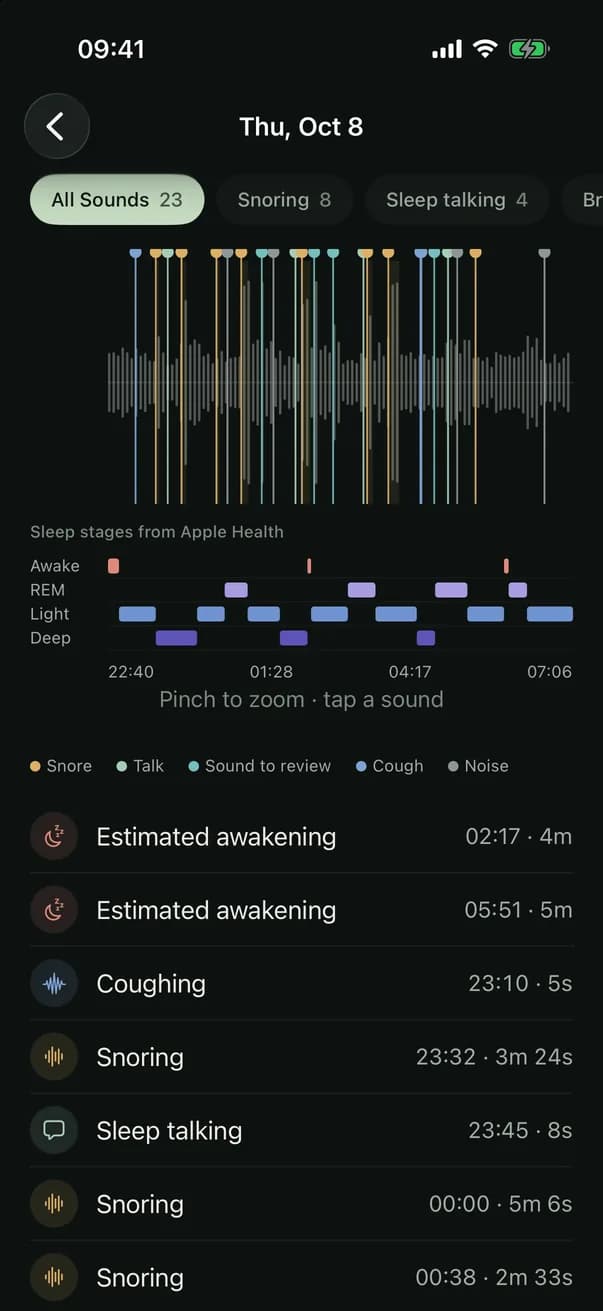
The app can save consented overnight sound clips for replay with a subscription. It does not perform an HSAT, read medical airflow sensors, compute a validated AHI or provide a diagnostic result. Any Apple Health readings are separate and depend on external compatible devices.

Questions
Can I get a home sleep apnea test without a sleep lab?
In selected adults, a clinician can order a medical HSAT to be performed at home. It is not the same as downloading a snoring app [1].
Can a normal home test rule out sleep apnea?
Not always. AASM recommends PSG after a negative, inconclusive or technically inadequate HSAT in a patient being evaluated for OSA [1].
Is AHI the number of times an app hears snoring?
No. AHI involves defined respiratory events per hour of measured sleep in clinical testing. Audio snoring counts are not interchangeable.
Sources
- 1Kapur VK et al. Clinical Practice Guideline for Diagnostic Testing for Adult Obstructive Sleep Apnea: An American Academy of Sleep Medicine Clinical Practice Guideline. J Clin Sleep Med. 2017;13(3):479-504.
- 2National Heart, Lung, and Blood Institute (NIH). Sleep Apnea: Diagnosis.
- 3Patil SP et al. Treatment of Adult Obstructive Sleep Apnea with Positive Airway Pressure: An American Academy of Sleep Medicine Clinical Practice Guideline. J Clin Sleep Med. 2019;15(2):335-343.
- 4Ramar K et al. Clinical Practice Guideline for the Treatment of Obstructive Sleep Apnea and Snoring with Oral Appliance Therapy: An Update for 2015. J Clin Sleep Med. 2015;11(7):773-827.