

Sleep apnea treatment: CPAP, oral appliances and other options
Obstructive sleep apnea (OSA) has several treatment options, but which one fits depends on a medical diagnosis, symptoms, other conditions and patient preferences. Positive airway pressure (PAP) is a guideline-supported treatment for adults with OSA [1]. Dentist-fitted oral appliances can be appropriate for some adults [2]. A phone recording does not prescribe or measure treatment effectiveness.
Last reviewed 22 October 2026. General information, not medical advice.
On this page6 sections
Which sleep apnea treatments are available?
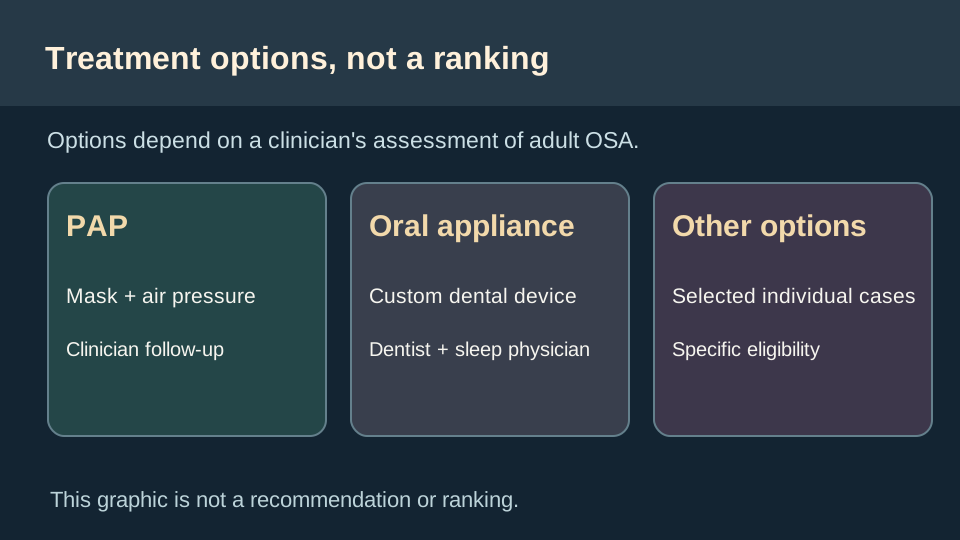
The options below are not a ranking for a particular person. A clinician considers whether the condition is obstructive or central, its severity, symptoms and other health issues before planning treatment. Treatments for central sleep apnea may differ; this overview focuses on adult obstructive sleep apnea [1].
Even if snoring sounds quieter after a change, that is not proof that breathing interruptions have resolved. Clinical follow-up is especially important if you have diagnosed OSA or persistent daytime sleepiness.
- Positive airway pressure (PAP): a device and mask maintain airway pressure during sleep [1].
- Custom oral appliance: a qualified dentist provides a device that advances the lower jaw when selected by a sleep physician [2].
- Addressing contributors: weight-related care, alcohol reduction and positional strategies may help some people, sometimes alongside an established therapy.
- Selected medications and procedures: options for particular adult populations or specific anatomical problems, considered with clinicians [3].
How do CPAP and APAP work?
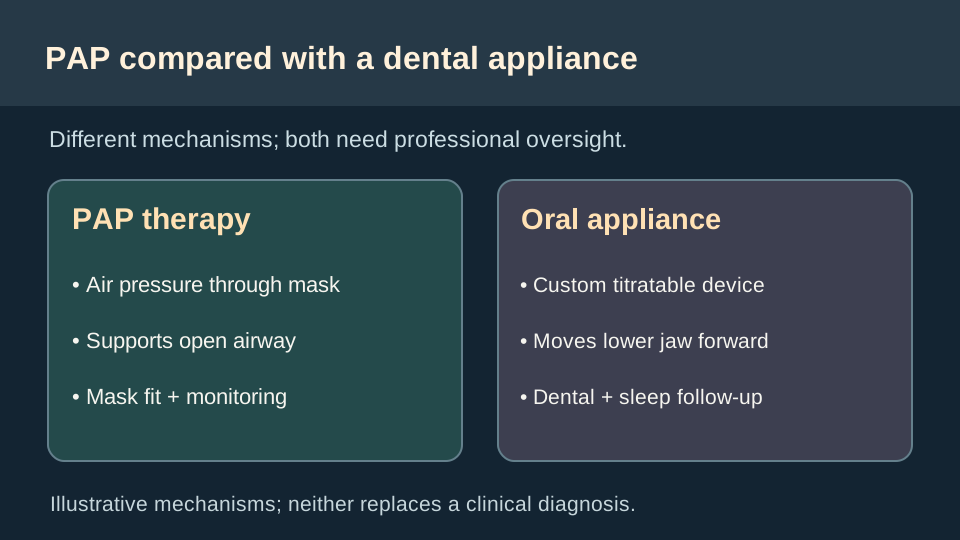
Continuous positive airway pressure (CPAP) delivers a set level of air pressure through a mask to help keep the upper airway open. Auto-adjusting positive airway pressure (APAP) varies pressure under its device algorithm. AASM guidelines support CPAP or APAP for ongoing adult OSA care [1].
If your mask is uncomfortable, leaks or you are struggling to use treatment, contact the prescribing team instead of stopping or changing settings independently. The guideline emphasizes education, troubleshooting and follow-up. Some other breathing disorders require a different approach [1].
After PAP starts, ask your care team when usage and treatment data will be reviewed, whom to contact about leaks or pressure discomfort, and what symptoms require reassessment. AASM recommends follow-up that includes objective usage and efficacy information, especially early in treatment; a quieter audio recording is not an equivalent measure [1].
When is a dental oral appliance considered?
A custom, adjustable (titratable) mandibular advancement appliance can be an option for people who cannot tolerate CPAP or prefer another treatment, as assessed by a sleep physician. A qualified dentist fits the device and checks for dental side effects or bite changes [2].
AASM/AADSM guidance also calls for follow-up sleep testing to help confirm or improve oral-appliance treatment effectiveness. A non-custom mouthguard bought without clinical assessment should not be represented as equivalent [2].
What about weight, alcohol, medication and procedures?
Where relevant, lifestyle and weight-management care can be part of an OSA plan. Alcohol can worsen snoring in some people [4]. Do not treat changes to alcohol or sleep position as a guarantee that diagnosed apnea is controlled.
In the United States, the FDA approved tirzepatide (Zepbound) on December 20, 2024, for moderate-to-severe OSA in adults with obesity, alongside a reduced-calorie diet and increased physical activity. This is a specific prescription indication, not a general sleep aid or advice for everyone with snoring [3]. See the FDA's approval announcement. Other countries' approvals and eligibility may differ.
Selected patients may also be assessed for surgery or implanted hypoglossal nerve stimulation. The appropriate referral and follow-up depend on anatomy and clinical findings, and these are not first-step self-care tools.
Questions for your sleep apnea treatment follow-up
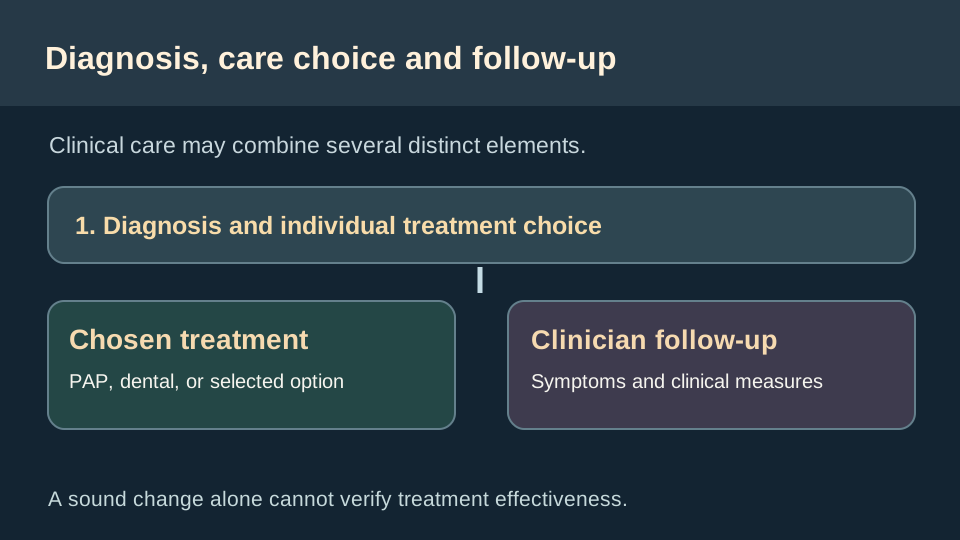
If you have already been diagnosed and prescribed treatment, a follow-up visit is the place to ask whether it is working and how to manage difficulties. AASM guidance calls for objective usage and efficacy review after PAP begins, together with practical education and troubleshooting [1]. A quieter night in a snoring app is not evidence that treatment is working or that breathing is no longer disrupted.
If you use a professionally fitted oral appliance, your qualified dentist can check comfort and bite changes while your sleep physician considers follow-up testing to confirm effectiveness [2]. Different treatments need different follow-up plans. This checklist is for a discussion with your care team, not instructions to adjust a medical device yourself.
- For PAP users: Who reviews device usage and treatment data, when will the first follow-up occur, and how should I report mask leaks, congestion, dryness or discomfort?
- For oral appliance users: Who checks fit, dental side effects and possible bite changes, and how will effectiveness be assessed with appropriate follow-up testing?
- If you are still sleepy or symptoms return: What needs reassessment, and should another clinical sleep test or specialist review be considered?
- Before changing a treatment: Which problems should prompt contacting the prescribing team, rather than stopping therapy or changing pressure or appliance settings on your own?
The AASM PAP guidance explains the value of early follow-up and objective monitoring. The AASM/AADSM oral appliance guideline recommends dental oversight and clinical follow-up testing.
How is treatment effectiveness checked?
A treating clinician may review symptoms, device use and applicable objective measurements or repeat an appropriate clinical test. Sleeping sound recordings, a watch estimate or a reduced snoring count alone do not establish successful apnea treatment [1][2].
See how apnea is diagnosed for test differences, what sleep apnea means for symptoms, and whether a phone app can detect apnea for the limits of audio. If treatment concerns arise, consult the treating clinician before changing or discontinuing a prescribed approach.
In the app
Where nighttime recordings can help
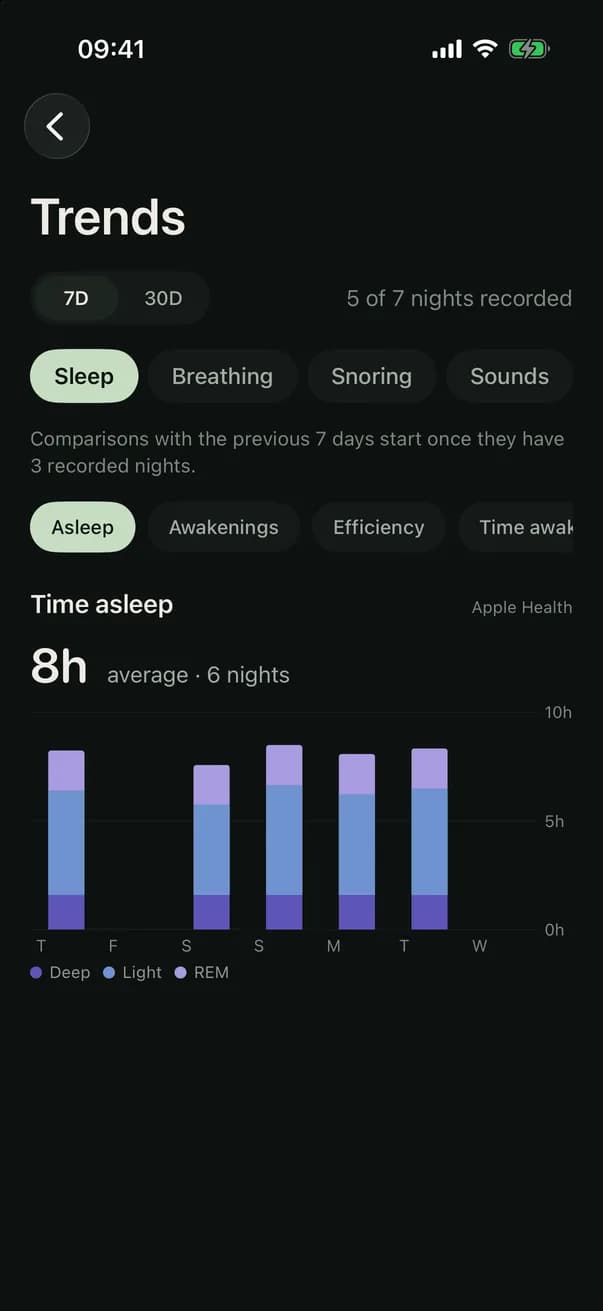
With a subscription, the app can organize room sounds so you can listen to audible changes across nights. It cannot prescribe treatment, measure an apnea index, diagnose OSA or confirm a therapy is working. For diagnosed apnea, follow the treatment plan and measurements recommended by your healthcare team.

Questions
Is CPAP the only treatment for sleep apnea?
No. CPAP and APAP are common guideline-supported adult OSA treatments, while custom dentist-fitted appliances and other options may suit selected people following clinical assessment [1][2].
Can treating my snoring cure sleep apnea?
Quieter snoring alone cannot prove that apnea is treated. Breathing events require appropriate clinical evaluation or follow-up [1].
Is there an FDA-approved sleep apnea medicine?
In December 2024, the U.S. FDA approved tirzepatide for moderate-to-severe OSA in adults with obesity, combined with diet and exercise. Prescription eligibility and national authorization vary [3].
Sources
- 1Patil SP et al. Treatment of Adult Obstructive Sleep Apnea with Positive Airway Pressure: An American Academy of Sleep Medicine Clinical Practice Guideline. J Clin Sleep Med. 2019;15(2):335-343.
- 2Ramar K et al. Clinical Practice Guideline for the Treatment of Obstructive Sleep Apnea and Snoring with Oral Appliance Therapy: An Update for 2015. J Clin Sleep Med. 2015;11(7):773-827.
- 3Eli Lilly and Company. FDA approves Zepbound (tirzepatide) as the first and only prescription medicine for moderate-to-severe obstructive sleep apnea in adults with obesity. 20 December 2024.A press release from the manufacturer.
- 4NHS. Snoring.