

Can an app detect sleep apnea? Phone, Watch and sleep tests
A regular phone snore recorder cannot diagnose sleep apnea or reliably rule it out. Consumer audio may capture snoring or gasping-like sounds, while compatible Apple Watches offer a separate notification feature for certain adults. Neither is a substitute for assessment and a clinical sleep test [1][2].
Last reviewed 22 October 2026. General information, not medical advice.
On this page6 sections
What a phone app can actually record
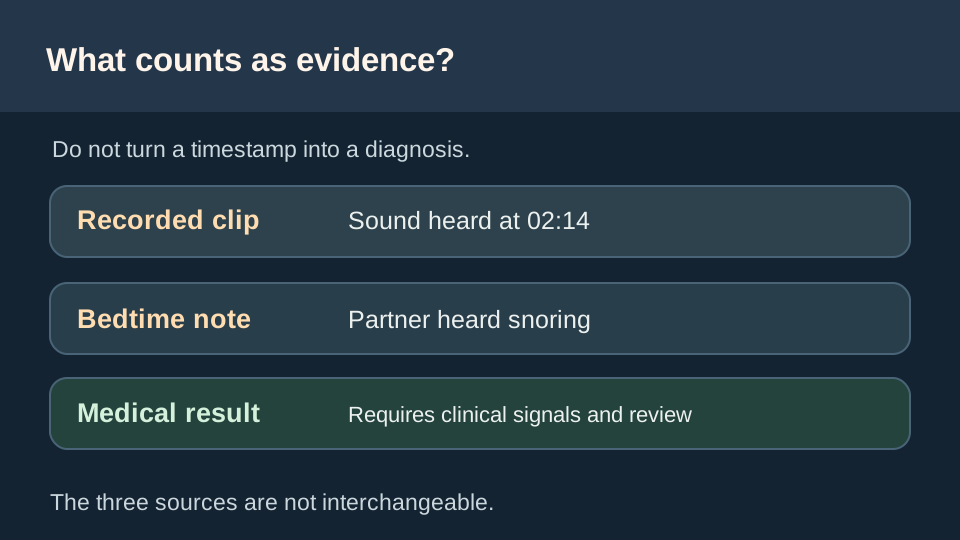
An iPhone microphone can record sound in the bedroom. That may be useful for identifying a noise you want to discuss with a clinician. But snoring loudness, a short silent interval, a 'gasp' classification or a count of detected sounds is not an apnea-hypopnea index (AHI) from a sleep study.
A clip also cannot measure airflow, respiratory effort or blood oxygen. Poor microphone positioning, background noise and bed partners make interpretation less certain. See how to record yourself sleeping for practical placement and privacy considerations.
What Apple's sleep apnea notifications actually do
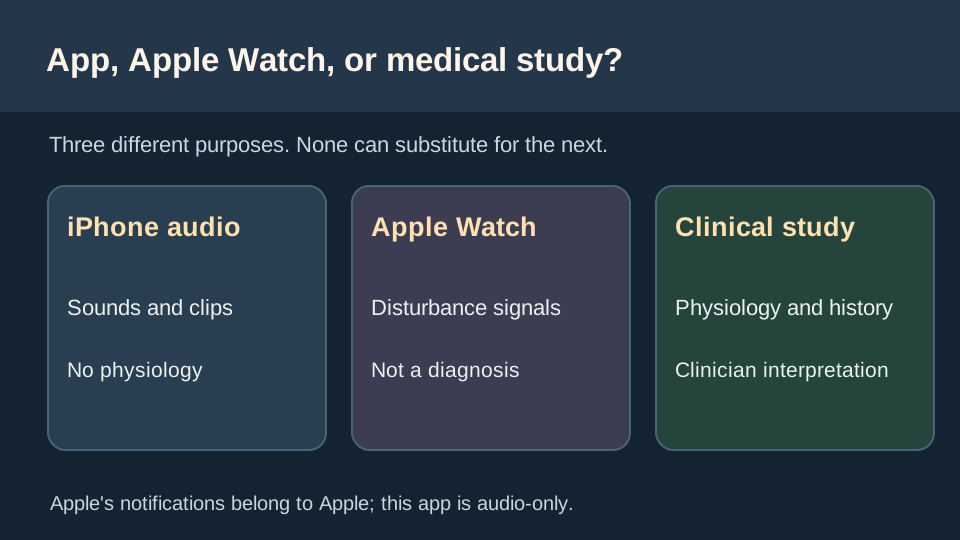
On compatible Apple Watches, Apple offers breathing-disturbance analysis using wrist accelerometer measurements across a 30-day period, when there are enough nights of data. The feature is intended for people aged 18 or older who have not already been diagnosed with sleep apnea [3]. Apple currently says at least 10 nights of tracking within 30 days are needed to analyze a period.
The feature is not available on every Apple Watch or in every country or region. As of October 2026, Apple's support page lists Apple Watch Series 9 or later, Apple Watch Ultra 2 or later, and Apple Watch SE 3, with compatible iOS/watchOS and sleep tracking enabled. If your device cannot use the feature, that says nothing about whether you have sleep apnea.
Apple explicitly says its notification is not intended to diagnose, treat or help manage sleep apnea. Not receiving an alert does not mean you do not have apnea. Eligibility, available models and settings can change; check Apple's current setup and limitations rather than relying on an app summary.
What only a clinical test is designed to assess
A sleep clinician can arrange laboratory polysomnography or, in selected adults, a suitable home sleep apnea test. These tests use dedicated sensors and clinical interpretation of breathing-related measurements [4]. A clinician also considers symptoms, associated conditions and whether another disorder is plausible.
If a home sleep apnea test is negative or inconclusive and concern remains, an in-lab test is recommended [4]. For the step-by-step process, read sleep apnea tests explained.
A useful checklist for interpreting consumer recordings
Sort observations into three groups rather than assigning a risk number.
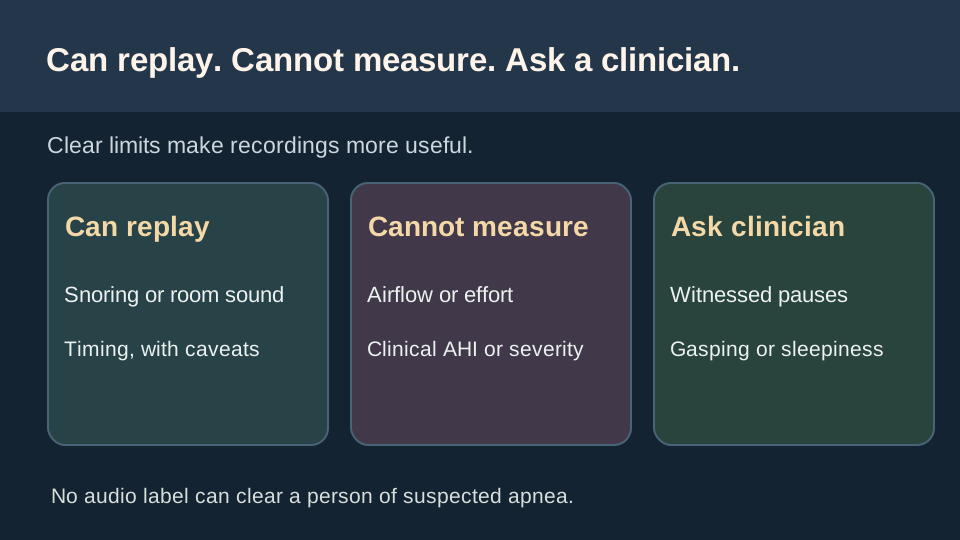
- Can replay: audible snoring, a loud noise, a timestamp and any voluntary notes.
- Cannot measure: actual airflow, respiratory effort, an accurate apnea index or the reason for silence.
- Clinician should assess: witnessed pauses, gasping, problematic daytime sleepiness or possible sleep apnea despite no audio findings [5].
A breathing-related sound classification can be a listening shortcut, not a medical alert. Do not delay an appointment to collect a longer set of recordings.
Where to check an Apple Watch notification and what to bring
If you have an eligible Apple Watch and have enabled Apple's separate feature, open the iPhone Health app, choose Browse, then Respiratory, and look for Sleep Apnea Notifications or Breathing Disturbances. Apple says this feature needs at least 10 tracked nights in a 30-day period [3]. Its current instructions explain how to export a detailed PDF for a clinician if a notification appears.
The Apple Watch feature is not built into this phone sound-recording app. It uses wrist motion data and its own eligibility rules; this app's room microphone neither runs Apple's notification algorithm nor performs the medical testing needed for a diagnosis. The absence of an Apple alert or a sound event in this app cannot rule out sleep apnea.
- No Apple option visible: verify device eligibility, age, region, compatible software and sleep tracking from Apple's current setup instructions. Do not infer a medical finding from a missing menu.
- An alert appears: save Apple's own report if you want to share it, and discuss the result and any symptoms with a medical professional. It is not an AHI result.
- No alert, but symptoms continue: seek care for witnessed pauses, gasping or significant sleepiness rather than waiting for another 30-day evaluation [5].
- Only phone audio available: a few consented example clips and a short symptom history can be optional context, but neither measures clinical respiratory events.
Apple's official support page details supported devices, notifications and how to export a report. For the medical workup, see sleep apnea test options.
Choosing next steps
If someone notices breathing pauses or gasping, or you are unusually sleepy, arrange medical advice regardless of what any app says [5]. You can optionally bring consented example audio or a symptom diary. An Apple Watch notification is another reason to contact a clinician, never a diagnosis.
For a plain-language explanation, see what sleep apnea is and snoring versus apnea.
In the app
The app observes audio; it is not a screening test
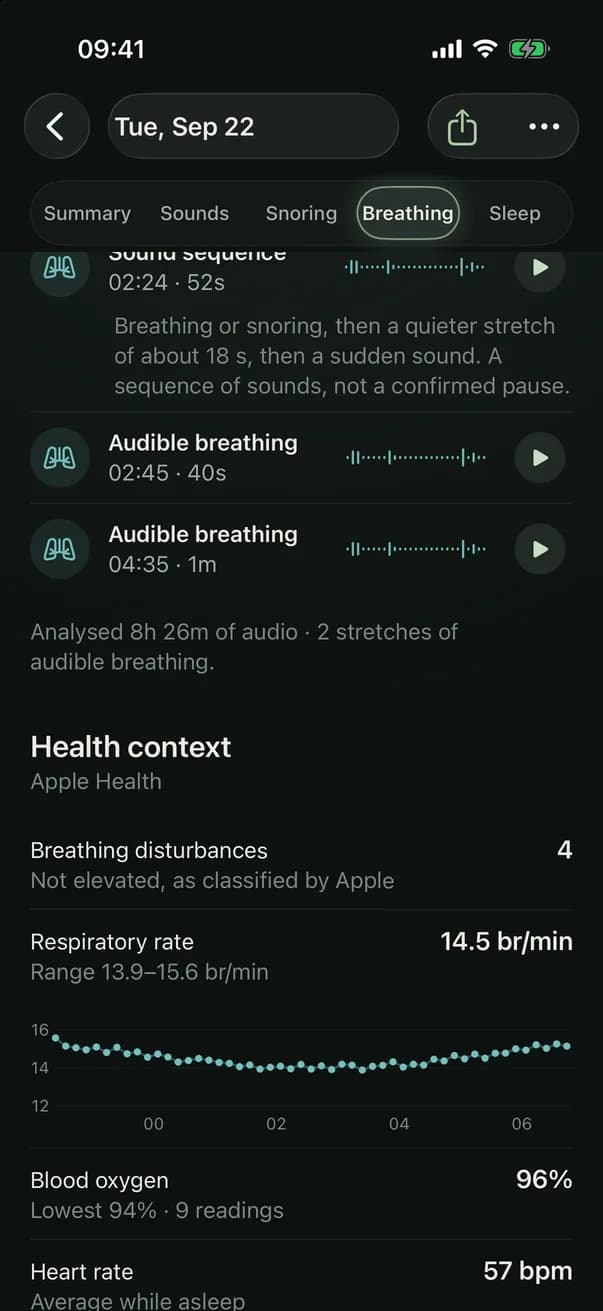
With a subscription, the app organizes sound recordings so you can replay what was audible. Apple Health measurements, when available, remain attributed to Apple Health. The app does not issue an apnea diagnosis, rule-out result, AHI or treatment recommendation.

Questions
Can a snoring app detect sleep apnea?
A typical sound recorder cannot diagnose or rule out sleep apnea. A clinical assessment and appropriate testing are needed [4][2].
Does no Apple Watch alert mean I am fine?
No. Apple says not all people with apnea receive a notification and the feature is not a diagnostic or monitoring tool. Consult a clinician if symptoms worry you.
Is a pause in an app recording the same as one found in a sleep study?
No. A silent clip might reflect positioning, quiet breathing or an unrelated recording issue, and there is no physiological confirmation.
Sources
- 1American Academy of Sleep Medicine. Health advisory: Sleep apps and devices that self-assess risk of obstructive sleep apnea.
- 2American Academy of Sleep Medicine. Consumer Sleep Technology: AASM position statement.
- 3Apple Newsroom. Apple introduces groundbreaking health features, September 2024.
- 4Kapur VK et al. Clinical Practice Guideline for Diagnostic Testing for Adult Obstructive Sleep Apnea: An American Academy of Sleep Medicine Clinical Practice Guideline. J Clin Sleep Med. 2017;13(3):479-504.
- 5National Heart, Lung, and Blood Institute (NIH). Sleep Apnea: Symptoms.