
What Snorezy hears
Five kinds of sound, and what they can't tell you
Snorezy analyses the night's audio on your iPhone and sorts what it finds into five categories, each with its own colour everywhere in the app. Here is what each one shows you, and where a microphone's knowledge ends.
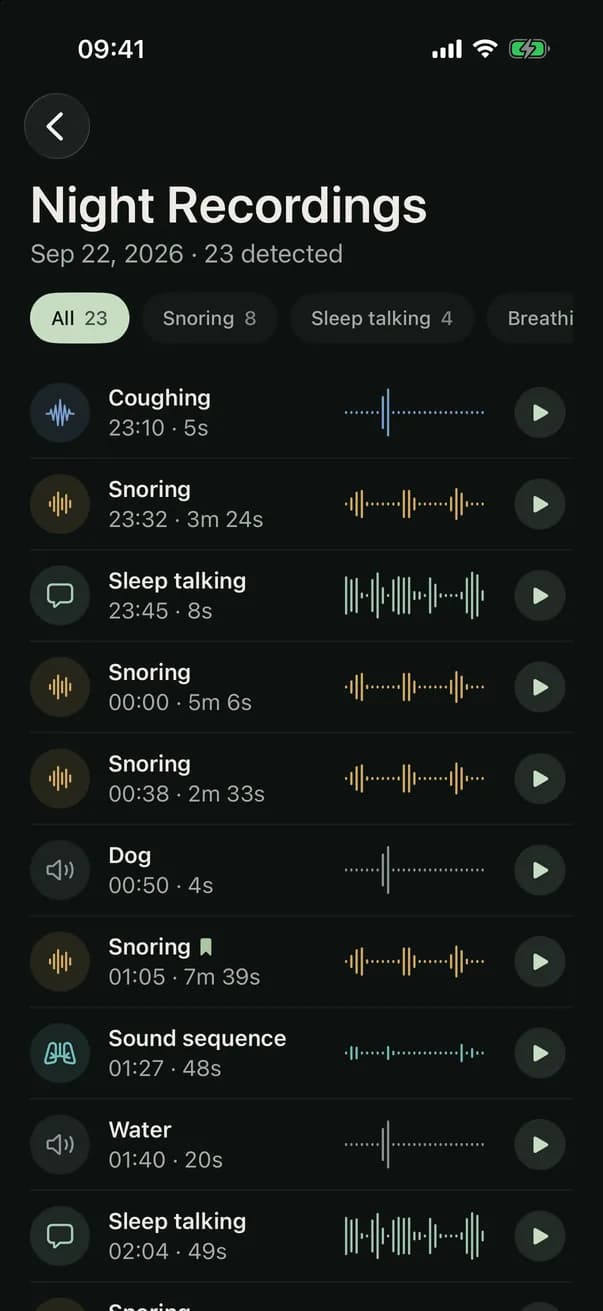
Snoring
The sound of tissue in your airway vibrating as you breathe.
In the report
Total snoring and its share of the night, episodes, the longest episode, intensity relative to your room, snoring hour by hour, and clips of the loudest and longest.
What it can't tell you
Why you snored, or whether your breathing was interrupted. Loud snoring isn't a diagnosis of anything.
Sleep talking
Speech, mumbling or laughing in your sleep.
In the report
Each moment as a clip, the longest one as a highlight, and how many there were.
What it can't tell you
What was said: speech is never transcribed. You listen, and nothing is written down.
Breathing sounds
Gasp-like sounds, audible breathing, and sequences where snoring or breathing gives way to a quieter stretch and then a sudden sound.
In the report
Counts and clips to review, each with the minute before it, alongside Apple Health's own readings when you use it.
What it can't tell you
Whether you have sleep apnea. A quiet stretch doesn't mean breathing stopped, and a microphone can't measure oxygen.
Coughing
Coughs through the night, always as their own category.
In the report
When they happened and how many, with clips.
What it can't tell you
Why you coughed. A cough that keeps you up for weeks is worth mentioning to a doctor.
Noises
Everything else a bedroom hears: a partner, a pet, a door, water, footsteps, traffic.
In the report
Loud moments on the timeline, and the sound Apple Health's awakenings were closest to.
What it can't tell you
Whether a noise woke you. Being close in time doesn't mean one caused the other.
How loud is my snoring?
Snorezy shows loudness relative to your room, such as “+30 dB above room”, and describes intensity in words. It doesn't claim a calibrated decibel figure, because a phone microphone isn't a calibrated meter: the reading depends on the phone, its distance from you, and the room.
Relative loudness is still useful, because it compares your nights with each other under the same conditions. Keep the phone in the same place each night and the comparison is fair.