

How much sleep do I need? Recommended hours by age
The sleep you need depends on age and individual circumstances. The CDC recommends adults ages 18 to 60 get at least seven hours per night, teenagers ages 13 to 17 get eight to ten hours, and younger children generally need more per 24 hours, including naps where relevant [1][2]. These are population recommendations, not diagnostic cutoffs.
Last reviewed 22 October 2026. General information, not medical advice.
On this page6 sections
- 4 to 12 months12 to 16 h
including naps
- 1 to 2 years11 to 14 h
including naps
- 3 to 5 years10 to 13 h
including naps
- 6 to 12 years9 to 12 h
- 13 to 18 years8 to 10 h
- Adults 18 to 607 or more
Recommended sleep hours by age
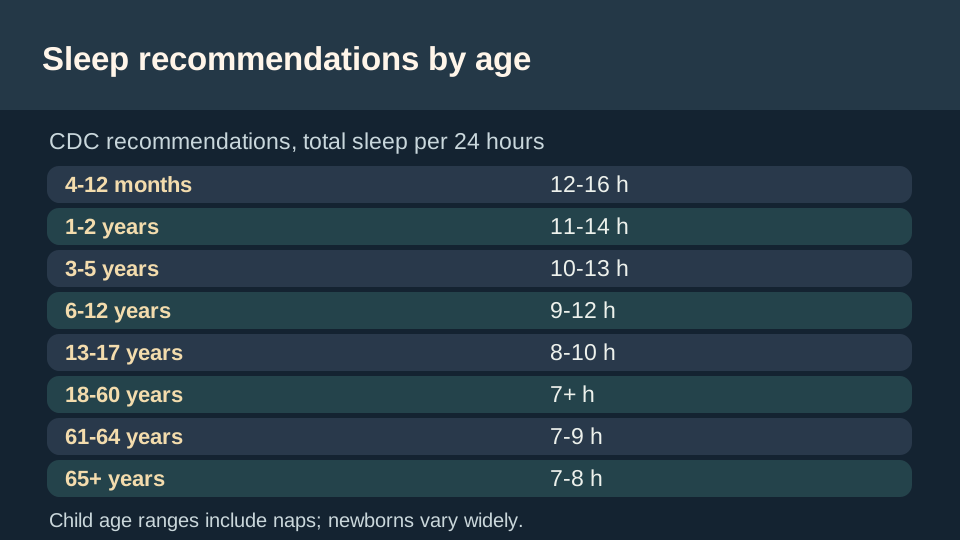
These age ranges follow the CDC's published sleep recommendations, which draw on AASM pediatric recommendations and adult expert consensus [1][2]. Count naps in the 24-hour total for infants and young children. The interactive age guide above lets you inspect a selected age range.
These figures describe the duration recommended for healthy people. An individual can have additional needs due to illness, disability or other circumstances.
- 4 to 12 months: 12 to 16 hours in 24 hours, including naps.
- 1 to 2 years: 11 to 14 hours in 24 hours, including naps.
- 3 to 5 years: 10 to 13 hours in 24 hours, including naps.
- 6 to 12 years: 9 to 12 hours per 24 hours.
- 13 to 17 years: 8 to 10 hours per 24 hours (the AASM pediatric consensus covers ages 13 to 18).
- 18 to 60 years: 7 or more hours per night.
- 61 to 64 years: 7 to 9 hours per night.
- 65 years and older: 7 to 8 hours per night.
The AASM did not set a formal duration recommendation for babies under four months because normal variation is wide; discuss infant-specific sleep concerns with a pediatrician rather than forcing a target.
How to apply sleep ranges without overinterpreting them
The table is a population guide, not an hourly quota for every individual. For a toddler, add nighttime sleep and naps within the same 24-hour period: 10 hours overnight plus a 1 hour 30 minute nap equals 11 hours 30 minutes in total. The recommended 11 to 14 hours for ages 1 to 2 includes both, not 11 to 14 hours at night plus extra naps [2].
The CDC age table also lists 14 to 17 hours per 24 hours for newborns aged 0 to 3 months, from its separate source. The AASM pediatric consensus used for older infant and child ranges did not set an under-four-month target due to wide variation; these are different source recommendations, not interchangeable clinical rules. Ask your baby's clinician about individual concerns and follow age-appropriate safe-sleep advice separately.
- Teenagers: CDC lists ages 13 to 17 at 8 to 10 hours; the pediatric AASM consensus covers ages 13 to 18. An 18-year-old should not treat that overlap as a medical cliff [2].
- Adults: seven or more hours applies to ages 18 to 60 in the adult consensus. It describes regular habitual sleep, not proof that one six-hour night caused harm [1].
- Older adults: the CDC table separately gives ages 61 to 64 a 7 to 9-hour range and ages 65 and older a 7 to 8-hour range. Persistent daytime symptoms need individual assessment even within those bands.
- Real-world estimates: time in bed is not the same as time asleep; keep a short diary if you need to understand repeated short nights.
For a practical comparison, use the sleep diary. The time-in-bed explanation below shows why a bed-to-wake duration is not the same as sleeping time.
Is six hours enough for an adult?
For most adults, six hours on a regular basis is below the adult consensus recommendation [1]. A single short night is not a diagnosis, but recurring short sleep and daytime problems are worth discussing with a clinician.
Adequate duration alone is not the whole picture: persistent awakenings, breathing symptoms and feeling unrefreshed can matter even when the clock shows enough time in bed. For ways to improve sleep habits, see how to sleep better.
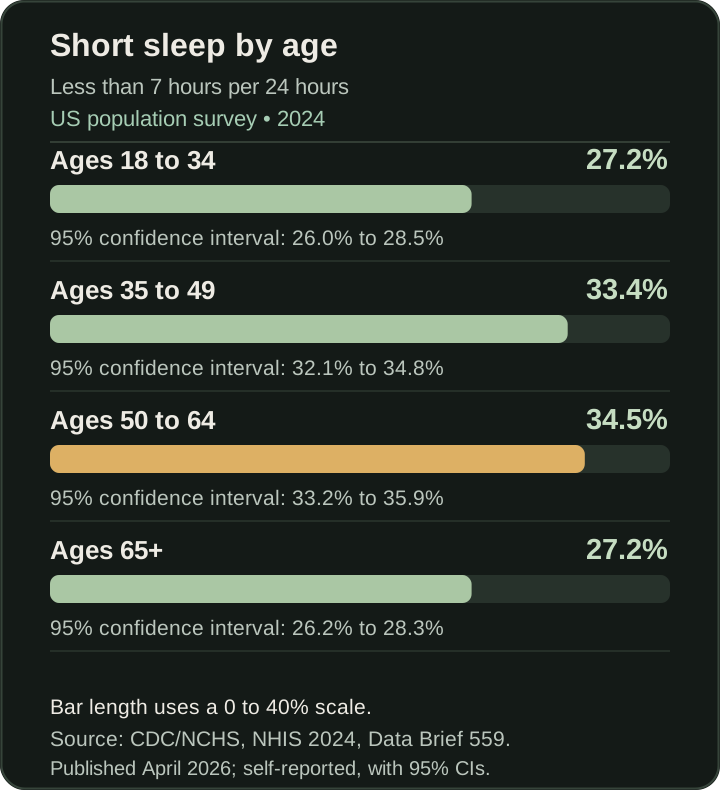
For context, the CDC National Center for Health Statistics' 2024 U.S. survey found that 30.5% of adults reported less than seven hours of sleep per 24 hours. This is a self-reported population statistic, not a personal benchmark, a measurement by this app, or a diagnosis. The age-group estimates below come from Table 1 of that report (published April 2026); their 95% confidence intervals reflect survey uncertainty.
- Ages 18 to 34: 27.2% (95% confidence interval 26.0% to 28.5%).
- Ages 35 to 49: 33.4% (95% confidence interval 32.1% to 34.8%).
- Ages 50 to 64: 34.5% (95% confidence interval 33.2% to 35.9%).
- Ages 65 and older: 27.2% (95% confidence interval 26.2% to 28.3%).
Time in bed versus time actually asleep
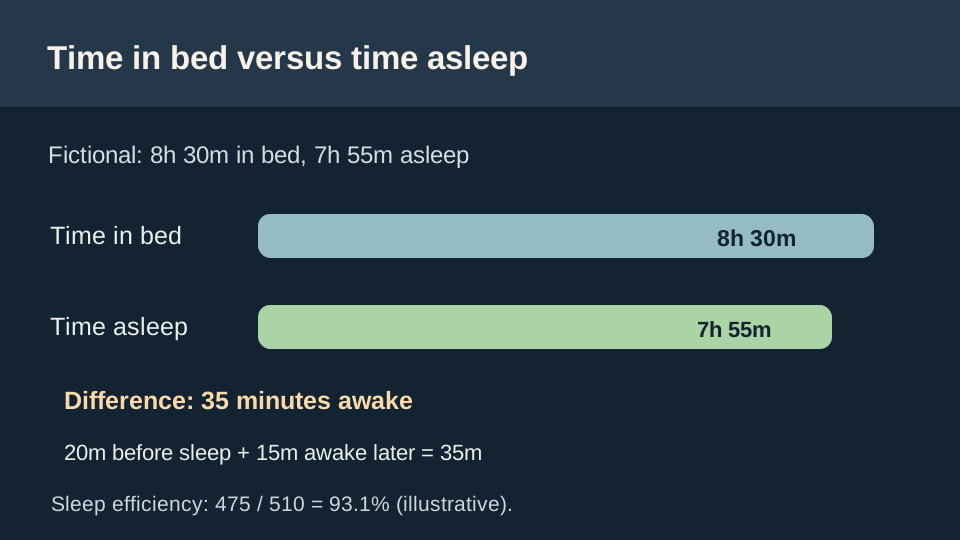
Time in bed includes trying to fall asleep and time spent awake during the night. For example, a fictional person spends 8 hours 30 minutes in bed, takes 20 minutes to fall asleep and is awake for another 15 minutes. Their time asleep would be 7 hours 55 minutes, not 8 hours 30 minutes.
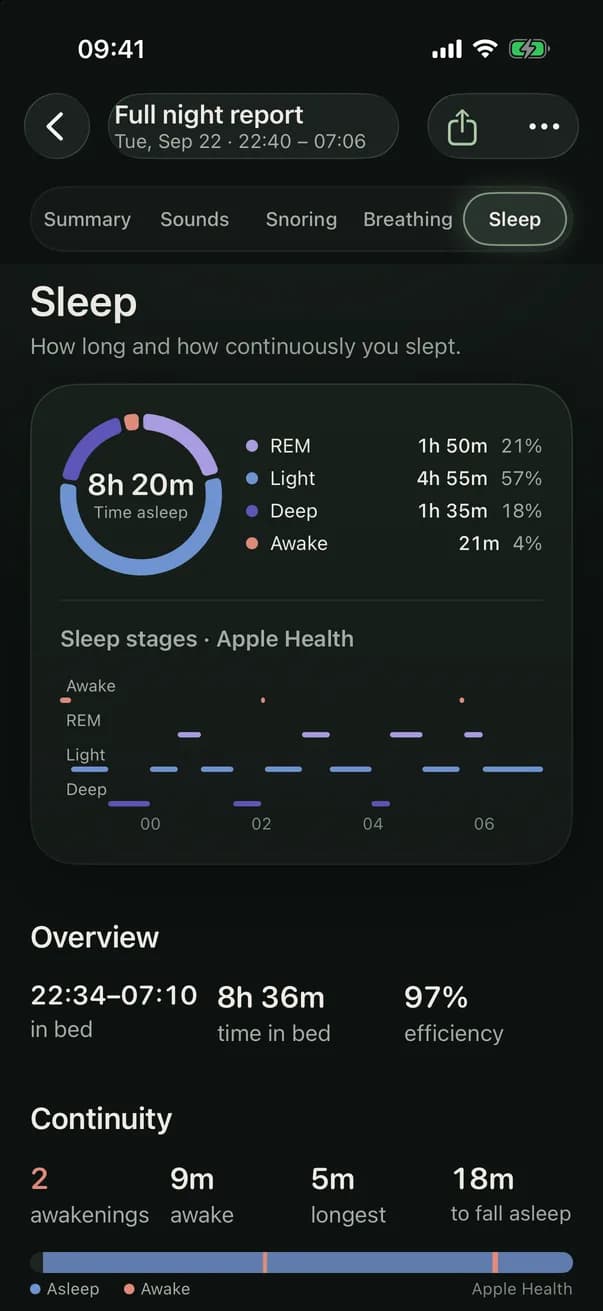
Sleep trackers use algorithms and data sources to estimate time asleep, so their totals are not clinical proof. The app can display available Apple Health estimates; a phone microphone by itself cannot determine how much of the night you slept.
How to compare sleep across a week
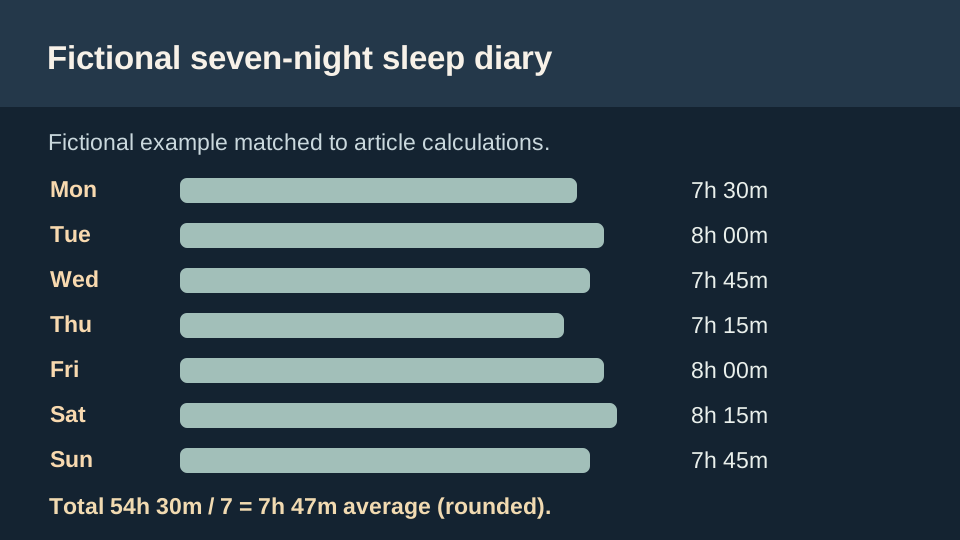
Use seven ordinary nights to see whether an unusually short or long night dominates your memory. For an illustrative example only, seven estimated sleep durations of 7h30, 8h00, 7h45, 7h15, 8h00, 8h15 and 7h45 average about 7h47 per night.
A self-reported diary and an Apple Health estimate can give different numbers. Try to compare like with like, keep the time scale consistent and avoid using a weekly average to dismiss persistent symptoms. The sleep-score guide explains the app's separate, product-specific scoring model.
When the recommended number is not the answer
If you regularly feel very sleepy, snore loudly with witnessed pauses or gasping, or have ongoing insomnia, talk to a healthcare professional even if your estimated duration falls within the table [3].
Children's sleep is age-dependent; bring concerns about persistent snoring, unusual breathing or marked daytime changes to a pediatrician. See child snoring and sleep stages for related context.
In the app
See sleep duration beside night sounds
With a subscription and appropriate Apple Health sleep data, the app can show estimated time asleep and time in bed next to separately recorded sounds. These are different measurement sources; the microphone does not establish a person's sleep duration or diagnose a disorder.

Questions
How much sleep does a teenager need?
CDC recommends 8 to 10 hours per 24 hours for teens ages 13 to 17, drawing on pediatric expert consensus [2].
Do naps count toward a toddler's recommended sleep?
Yes. Ages 1 to 2 have a recommendation of 11 to 14 hours per 24 hours including naps [2].
Does staying in bed eight hours mean I slept eight hours?
No. Time in bed includes waking before and during sleep. A wearable may estimate sleep duration, while a microphone alone cannot calculate it.
Sources
- 1Watson NF et al. Recommended Amount of Sleep for a Healthy Adult: A Joint Consensus Statement of the American Academy of Sleep Medicine and Sleep Research Society. J Clin Sleep Med. 2015;11(6):591-592.
- 2Paruthi S et al. Recommended Amount of Sleep for Pediatric Populations: A Consensus Statement of the American Academy of Sleep Medicine. J Clin Sleep Med. 2016;12(6):785-786.
- 3NHS inform. Obstructive sleep apnoea (OSA).