

Sleep diary template: what to track for two weeks
A sleep diary is a daily record of when you tried to sleep, when you woke, and the habits or interruptions you remember. A typical one covers 14 days and is filled in daily [1]. You can print or save our blank two-page diary, edit the 14-day CSV, or use the shorter seven-night sound-observation log on this page. Bring your notes to a clinician if sleep problems persist; the diary is a record, not a test.
General information, not medical advice.
On this page5 sections
7-night observation log
Use these seven entries for bedtime context and what you noticed about sounds. This is a shorter companion to the full 14-day sleep diary, not a substitute for tracking naps, medicines or wake-ups. Entries aren't stored by this tool or sent by the log. Download your CSV before closing or refreshing the tab. Your browser may warn about unsaved entries, but not every browser or navigation method can display that warning.
Night 1
Night 2
Night 3
Night 4
Night 5
Night 6
Night 7
Need a full two-week diary? Choose a blank template: 7-night snoring log and editable 14-day sleep diary (CSV), or print a blank 14-day diary / save as PDF. The printable worksheet opens in a new tab.
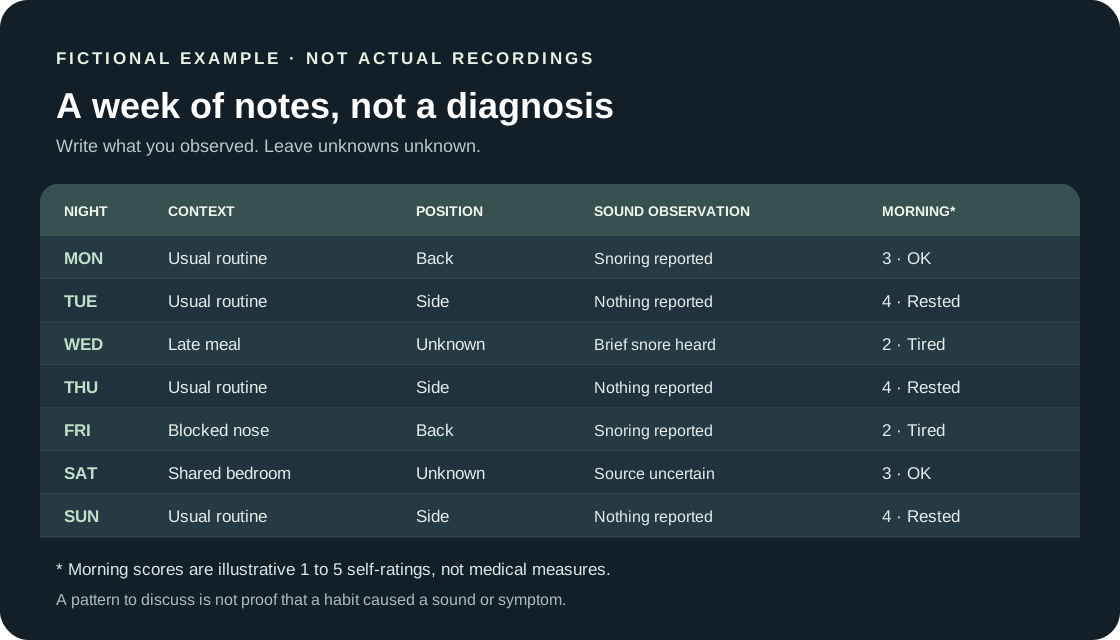
See how a week of notes looks
This illustration is fictional. The position and sound entries are observations, not measurements, diagnoses or evidence that one habit caused another.
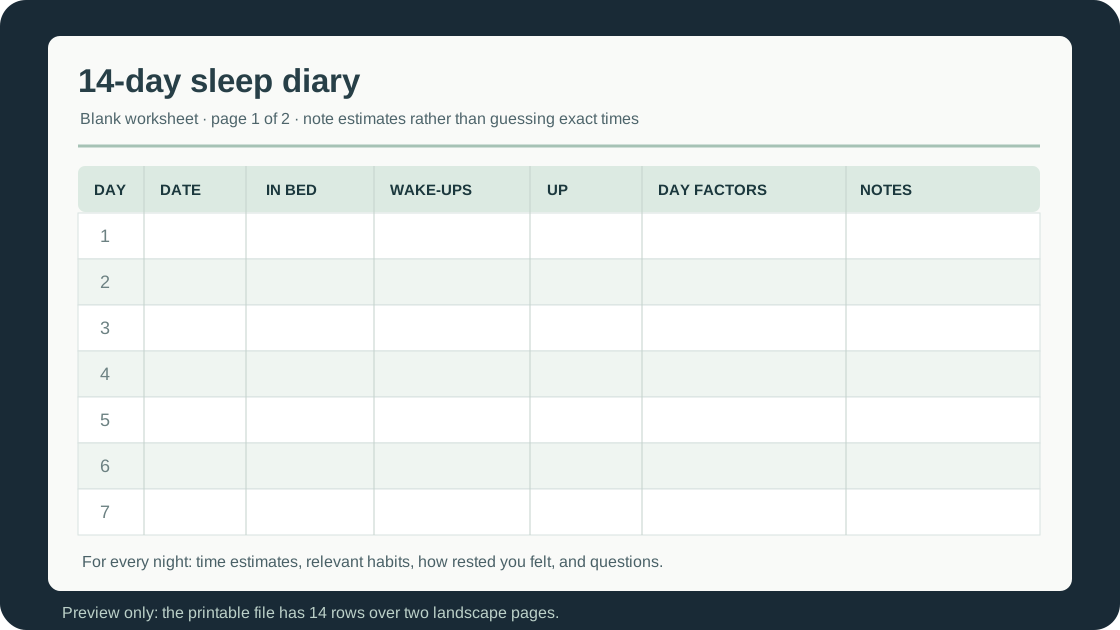
Prefer a paper diary?
The blank two-page worksheet has fourteen rows, space for wake-ups and daily factors, and no sample personal information. Open it to print or use your browser's Save as PDF option. The CSV above is better for editing on a computer.
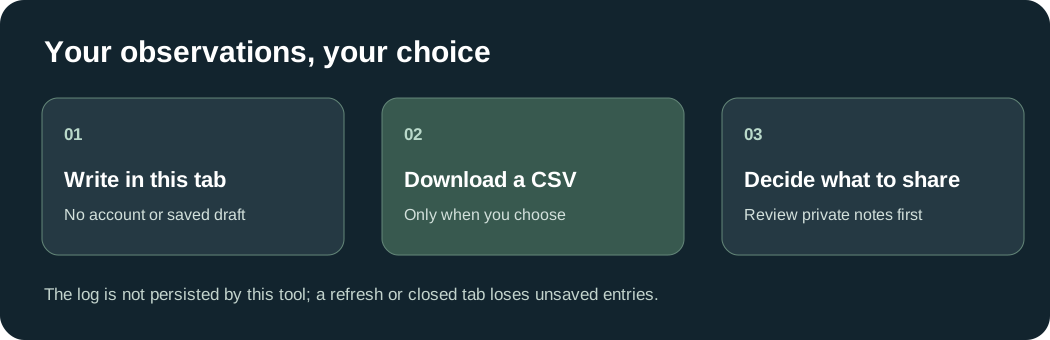
Privacy before sharing
The seven-night form exists only in this open tab, and reloading loses its entries. Downloading creates a file on your device that you control. Review your notes and remove anything you do not want a clinician or other recipient to see before sharing.
What to write down each day
Keep the blank 14-day sheet by your bed. Jot down relevant habits in the evening, then complete the sleep and morning columns soon after you wake. Estimates are useful; invented precision is not.
- Bedtime: when you got into bed, and roughly when you tried to sleep.
- Falling asleep: about how long it took.
- Waking in the night: how many times you remember, and roughly when.
- Morning: when you woke for good, and when you got up.
- Naps, caffeine, alcohol, exercise and medicines: write the time, if relevant, rather than guessing later [1].
- How rested you felt in the morning, and how sleepy you were during the day, each on a scale of 1 to 5.
- Anything else: a cold, a blocked nose, a late meal, a broken night with a baby.
- What someone else noticed: snoring, talking, gasping or pauses in your breathing.
- What a recording heard, if you made one: the time of a snore, talking, a cough or a room noise. How to record yourself sleeping explains phone placement and why audio is not a medical test.
Why two weeks
One night is a snapshot. Fourteen consecutive nights capture workdays, weekends and normal variation. The American Academy of Sleep Medicine's sleep education site recommends completing a typical two-week diary daily [1]. You do not need to wait for perfect sleep to start.
Keep what you remember apart from what was measured
If you record nighttime audio or use a wearable, use separate labels for your memory, an observed or recorded sound, and a device estimate. A phone can record a room sound, but it cannot establish who caused it or diagnose a sleep condition. Consumer trackers estimate sleep, and published device comparisons show they may identify waking less reliably than sleeping [2].
Reading it back
At the end of two weeks, look for repeatable questions rather than a verdict from a single night:
- How far your bedtime and wake time move between weekdays and weekends.
- Whether bad nights follow caffeine or late naps, which a diary can reveal [1], or an evening's drinking.
- The difference between time in bed and your estimated time asleep. How much sleep do I need? explains why those are not the same.
- Whether tired days follow short or broken nights, or neither.
Fictional example: A Friday entry notes both a blocked nose and reported snoring. A single overlap does not establish that congestion caused the sound. Put unknowns in the unknown column; do not count an unreported snore as a snore-free night. Write down questions for a clinician as you go.
Taking it to a doctor
A completed diary shows a clinician your sleep schedule, habits and self-reported symptoms [1]. For recurring awakenings, see why you wake during the night. Do not wait to finish 14 days if someone witnesses pauses in breathing or gasping, or you are very sleepy in daytime: talk to a doctor [3]. A phone recording cannot rule sleep apnea in or out. Before sharing any notes, check what is included. The seven-night log on this page keeps typed entries only in the open browser tab's memory; you choose whether to export a CSV, so download it before refreshing or closing the page. This does not describe storage or privacy settings of the separate iPhone app.
In the app
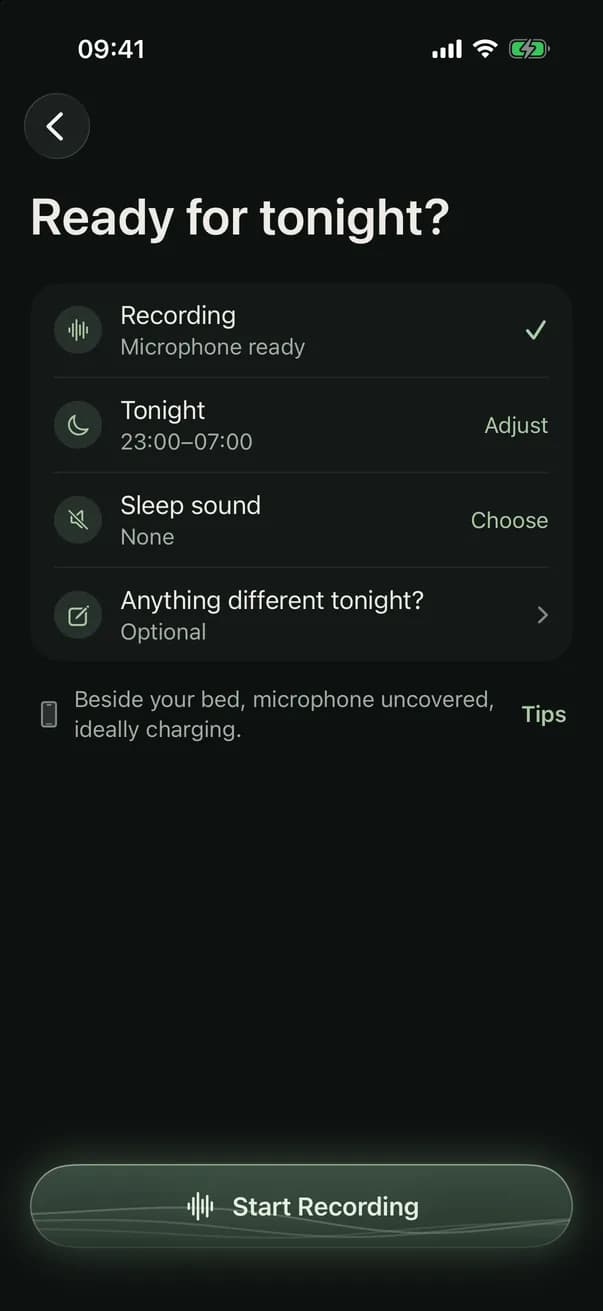
Use it with the app
The app's bedtime notes cover part of a diary. Before you sleep, "Anything different tonight?" records sleep position, congestion, alcohol, a late meal, a nasal strip, a mouthguard or an extra pillow, and in the morning you rate how rested you felt from 1 to 5. The recording adds what the night sounded like, and Apple Health, if you use it, adds time asleep and awakenings, each labelled with its source. Trends compares the nights you noted with the others, as a pattern, not a cause.
It doesn't log caffeine, naps, medicines or daytime sleepiness, so keep the diary for those. Recording and reports need a subscription; plans and prices are shown in the app.

Questions
Do I need exact times?
No. Rough times are more useful than invented precision, and a blank is better than a guess.
Can I download a 14-day sleep diary?
Yes. Download the blank 14-day CSV to edit, or open the printable two-page worksheet and use your browser's Print / Save as PDF option. The seven-night log exports only what you enter. Its fields are not saved; download before refreshing or closing this page.
Can a sleep tracker replace a diary?
Not entirely. Many apps and trackers include a sleep diary [1], but a tracker can't know about your coffee, your naps or how you felt. Use the tracker for its estimates and the diary for what only you know.
Sources
- 1American Academy of Sleep Medicine, Sleep Education. Sleep Diary.
- 2Chinoy ED et al. Performance of seven consumer sleep-tracking devices compared with polysomnography. Sleep. 2021;44(5):zsaa291.A small study of healthy young adults, testing particular device models.
- 3NHS. Snoring.