

White noise vs pink noise vs brown noise for sleep
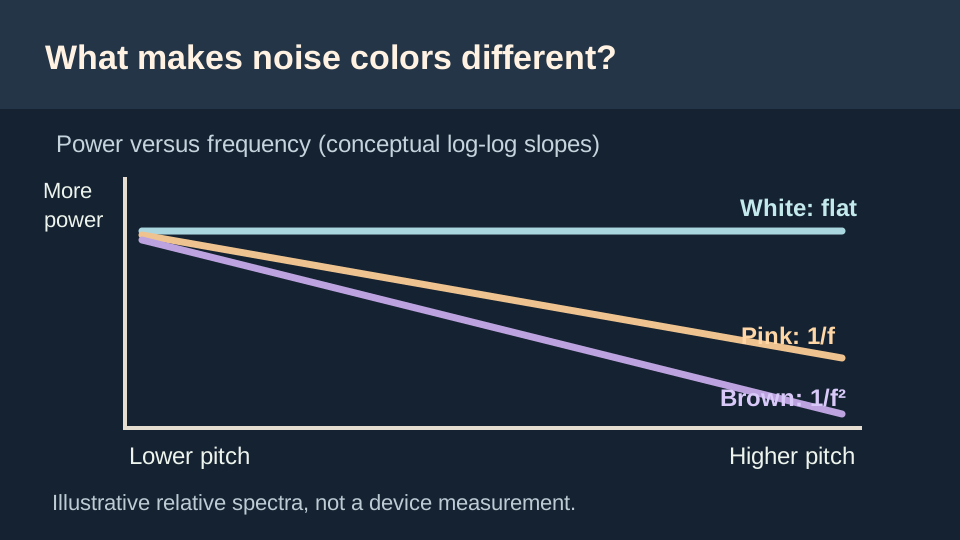
White, pink and brown noise differ mainly in how their sound energy is distributed across frequencies. White has roughly equal power per hertz, pink emphasizes lower frequencies, and brown emphasizes them even more. None is proven to be the best sound for sleep. Use the player below to compare how they sound at a comfortable volume.
Last reviewed 22 October 2026. General information, not medical advice.
On this page5 sections
Listen
Generated in your browser. Start quietly.
- White noiseBright, consistent background noise.
- Pink noiseSofter, balanced background noise.
- Brown noiseDeeper, lower-frequency noise.
These sounds are generated in your browser, for listening only.
What is the difference between the three noise colors?
They are categories of broadband noise, not specific recordings of rain or wind. The idealized power spectrum has a distinct slope for each color: flat for white noise, falling approximately with 1/f for pink, and with 1/f squared for brown. Real speakers and software filters are approximations, and perceived pitch and loudness depend on playback.
White noise often sounds bright or hiss-like. Pink noise has a softer, lower-frequency emphasis. Brown noise commonly sounds deeper and more rumbly. Natural rain, rivers and fans can resemble them but are not necessarily pure colored noise.
Try all three sounds rather than relying on descriptions
Use the comparison player near the top of this page. Begin at a low volume, try white, pink and brown in turn, and choose the sound that is least distracting to you. A continuous background sound may help make intermittent room noises less noticeable, but adding sound to an already quiet bedroom may not help.
Listening preference and a measurable sleep benefit are separate questions. The room-noise and awakenings guide explains what a sound recording can and cannot establish.
A practical way to compare white, pink and brown noise
Try the three colors at a comfortable, low listening level in the on-page comparison player. They can seem unequally loud even when the volume control stays at the same position, because the balance of high and low frequencies changes. Do not turn up a sound to make it feel as loud as a brighter one.
Choose by the actual problem you want to solve: a steady background sound might make a sporadic hallway noise less noticeable, while in an already quiet bedroom silence may be preferable. A sound that is pleasant for a minute may become distracting after a longer time. This is a preference check, not a medical sleep test.
- First listen in a quiet moment: begin softly with white, then pink, then brown; notice hiss versus lower-frequency rumble, not a supposed health benefit.
- Check the actual playback setup: speakers, room acoustics and device equalizers can alter the sound. Keep volume conservative and avoid placing a speaker by your pillow.
- If masking a disturbance: see whether the intrusive sound seems less noticeable without increasing volume; address the original noise source where possible.
- If sleep gets worse or you become irritated: stop the playback. Do not leave a sound running louder or longer solely to chase a sleep metric.
For why frequent awakenings have many possible causes, use waking up at night. Continuous noise is not a treatment for insomnia, snoring or sleep apnea [1].
Does white or pink noise improve sleep?
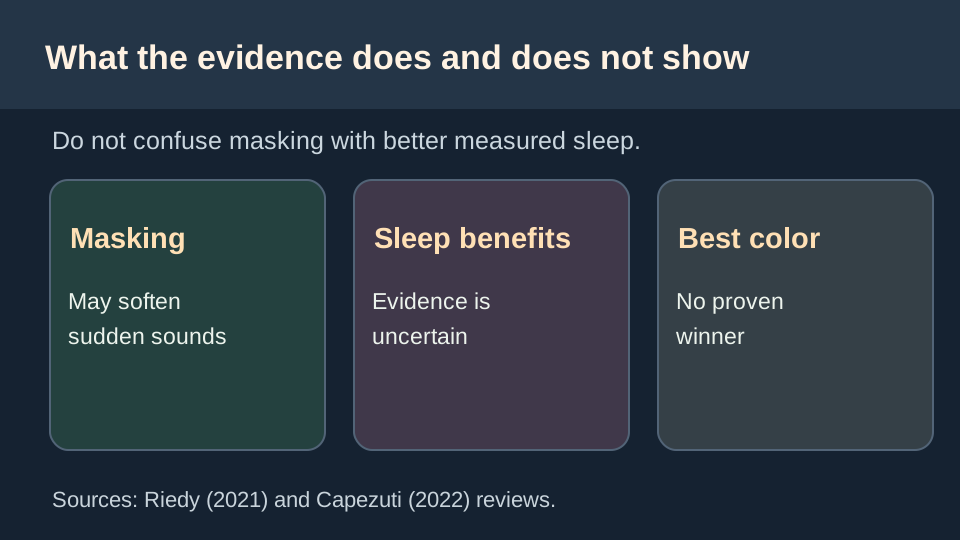
Evidence is mixed and often low quality. A systematic review of 38 studies found very low-quality evidence that continuous broadband noise improves sleep [1]. Another systematic review of auditory stimulation likewise found no strong evidence for sleep improvement, with substantial study differences and limitations (Capezuti and colleagues, 2022).
Masking is the plausible practical use: a steady sound may make an intermittent neighbor, hallway or traffic noise seem less abrupt. That is not a guarantee of fewer awakenings, deeper sleep or reduced snoring. These sounds do not treat sleep apnea or chronic insomnia.
How to choose a safe, practical setup
Start quietly, avoid placing a speaker next to your ear, and use a timer if continuous sound becomes distracting. Do not assume that longer or louder playback is better. People who are sensitive to noise may prefer a quiet bedroom, earplugs used appropriately, or addressing the actual noise source.
If the bedroom disturbance is part of ongoing difficulty sleeping, look at the broader how to sleep better guide. For long-term insomnia, professional evidence-based care matters more than selecting a noise color [2].
In the app
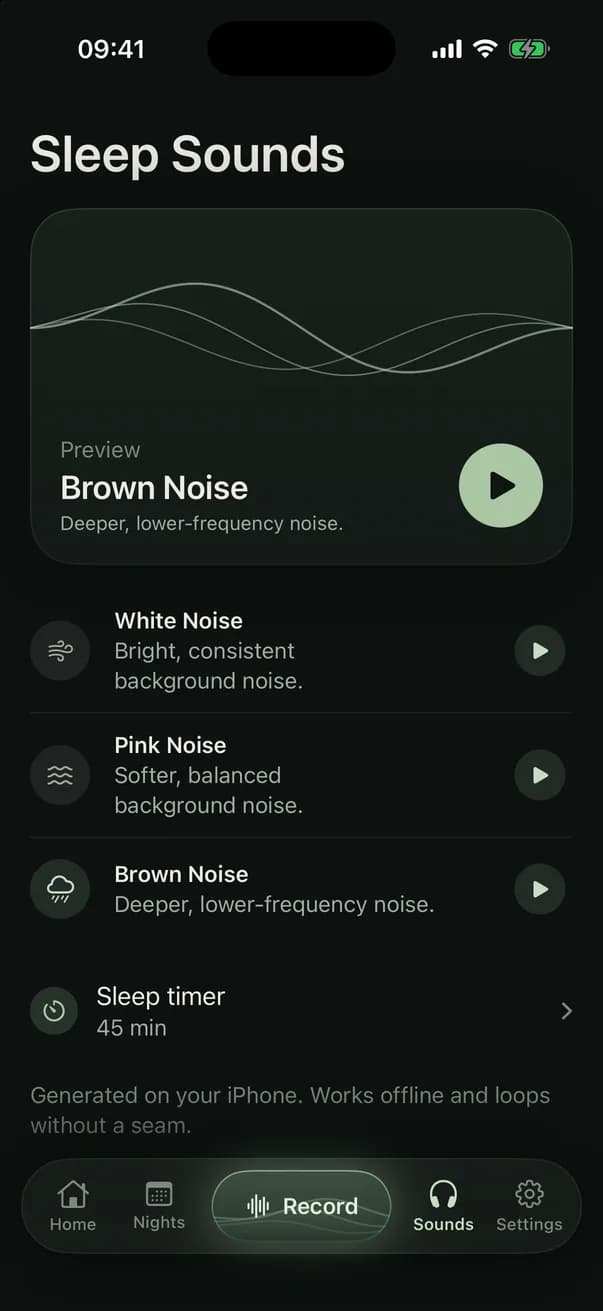
Play a sleep sound on iPhone
The app generates white, pink and brown sound on the iPhone, plays it without an internet connection, and can fade it out on a timer. Sleep sounds require a subscription. The player on this page is a listening comparison, not a demonstration of treatment efficacy.

Questions
Is brown noise better than white noise for sleeping?
Studies have not shown that brown noise helps sleep more than white or pink noise [1]. It sounds deeper, and which one you like is a matter of preference.
Does pink noise increase deep sleep?
It is not established that playing a general pink-noise loop improves deep sleep. Research protocols differ, and a consumer sound player should not promise stage changes.
What does pink noise sound like compared with white noise?
Pink noise generally has more relative low-frequency energy and sounds softer or less hiss-like than white noise, depending on the speaker and volume.
Sources
- 1Riedy SM, Smith MG, Rocha S, Basner M. Noise as a sleep aid: A systematic review. Sleep Med Rev. 2021;55:101385.
- 2Edinger JD et al. Behavioral and psychological treatments for chronic insomnia disorder in adults: an American Academy of Sleep Medicine clinical practice guideline. J Clin Sleep Med. 2021;17(2):255-262.